A useful image prompt is not a pile of adjectives. It is a short production brief: what is in the frame, what must stay consistent, where the scene happens, how it is lit, and how the camera should see it.
The examples below were generated on Elyvie with Z-Image Turbo at 9 steps. They are the same public examples shown on the free AI image generator, not outputs borrowed from another model. On July 29, 2026, six successful generations on one RTX 5090 took 11.7–20.3 seconds of worker execution, with a 12.2-second median. The slowest result included model warm-up.
A prompt structure you can reuse
Write in this order:
- Medium and subject — editorial portrait, anime key visual, product photograph.
- Identity anchors — fictional adult age, hair, clothing, defining features.
- Setting and action — the place, weather, pose, and what is happening.
- Light and palette — window light, blue hour, pink and indigo.
- Camera and composition — 50mm lens, chest-up, wide establishing shot.
- Output constraints — original character, no logo, no text, no watermark.
This order makes the important nouns easy to find and keeps style words from overwhelming the subject.
1. Character portrait · 4:5
Editorial character portrait of a fictional 28-year-old woman with a silver bob haircut and amber cybernetic eyes, translucent raincoat over black tailoring, neon magenta and indigo city reflections, confident expression, chest-up composition, cinematic rim light, 85mm lens, highly detailed fashion photography, original character, no text, no watermark.
Why it works: the age and “fictional” label establish an adult original subject. Hair, eyes, and outerwear are identity anchors. “Chest-up,” “rim light,” and “85mm” define the shot rather than asking the model to invent a camera.
2. Anime character · 1:1
Anime key visual of a fictional 24-year-old adult astronomer with long midnight-blue hair, standing inside a circular moon observatory, cream flight jacket with coral details, star maps floating in the air, expressive curious eyes, refined cel shading, crisp line art, deep indigo and pink palette, original character design, square composition, no text, no watermark.
Why it works: it names one animation treatment—refined cel shading—then supports it with line quality and a restrained palette. The profession, jacket, and observatory create a character concept rather than a generic anime face.
3. Photorealistic editorial portrait · 4:5
Photorealistic editorial portrait of a fictional 32-year-old Black male creative director on a quiet rain-washed street at blue hour, tailored charcoal coat, warm window light reflected on wet pavement, natural skin texture, calm direct gaze, 50mm lens, shallow depth of field, cinematic color grade, adult, original person, no logo, no text, no watermark.
Why it works: “natural skin texture” is more useful than “perfect skin.” The cool blue-hour environment and warm window reflection give the model a simple two-color lighting plan.
4. Fantasy environment · 3:2
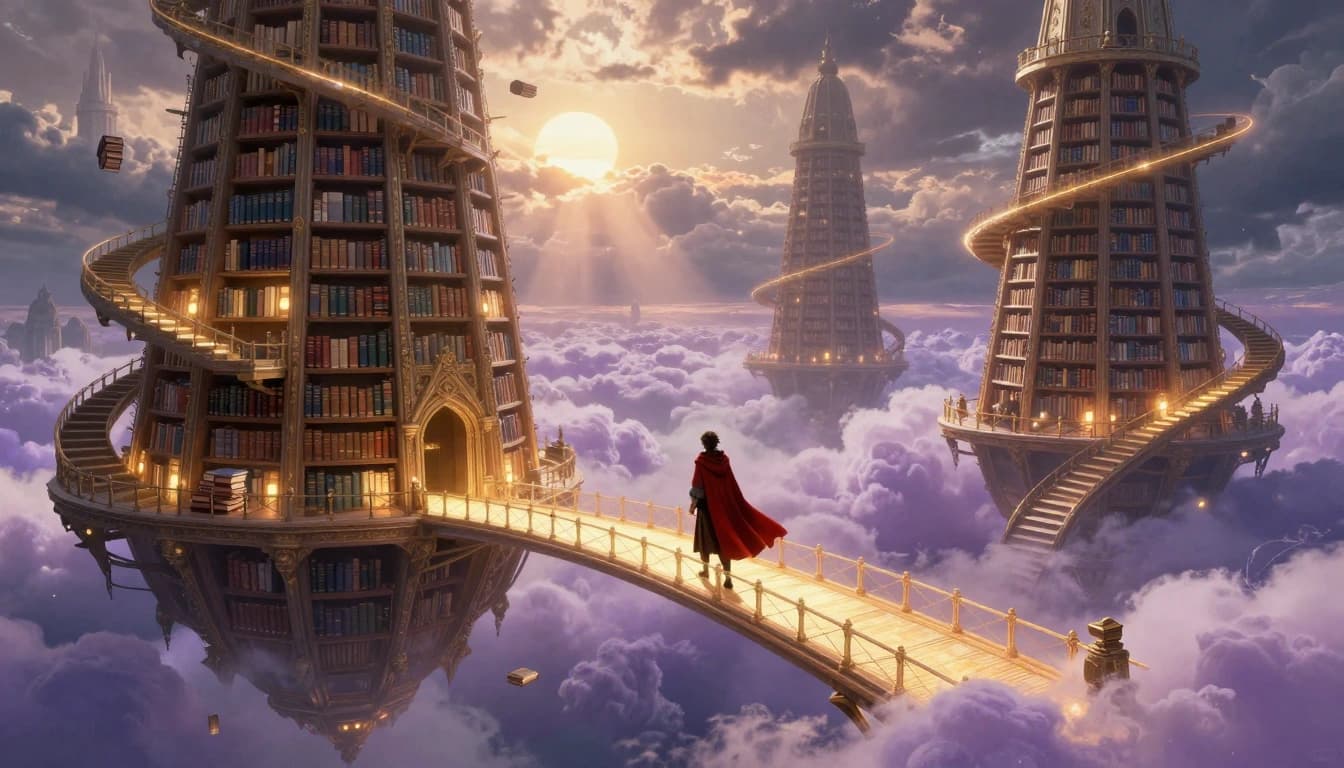
Epic fantasy concept art of a vast library floating above lavender clouds, a fictional adult cartographer in a red cloak crossing a luminous bridge, impossible staircases, glowing books orbiting ancient towers, sunrise breaking through storm clouds, intricate environmental storytelling, painterly realism, wide cinematic composition, no text, no watermark.
Why it works: the red cloak gives the eye a focal point while the library towers carry the scale. “Wide cinematic composition” makes this a setting first and a character image second.
5. Cinematic landscape · 3:2
Cinematic landscape of a black-glass monolith standing in a rose-colored desert after rain, shallow mirror pools, distant violet mountains, a tiny fictional adult traveler for scale, dramatic sunset beams, atmospheric haze, science-fiction film still, anamorphic wide composition, highly detailed, no text, no watermark.
Why it works: one dark geometric object contrasts with a pale landscape. The tiny traveler communicates scale without taking over the frame.
6. Product editorial · 1:1
Luxury editorial product photograph of an original unbranded perfume bottle made from smoky violet glass, suspended above folded translucent pink fabric, tiny water droplets, sharp studio highlights, black-to-plum gradient background, premium magazine art direction, square composition, clean product styling, no logo, no text, no watermark.
Why it works: material, support surface, light, and background are all specified. “Original unbranded” prevents the brief from depending on a real trademark.
Which aspect ratio should you choose?
| Frame | Elyvie example output | Best use |
|---|---|---|
| Portrait 4:5 | 832 × 1216 | Characters, fashion, profile art |
| Square 1:1 | 1024 × 1024 | Anime, products, avatars |
| Wide 3:2 | 1344 × 768 | Landscapes, environments, story frames |
Do not put “portrait” in the prose and then select a wide frame. Composition language and the actual frame should agree.
A practical iteration rule
Change one layer at a time. First lock the subject and frame. Next adjust the setting. Then tune light and camera. If you rewrite the subject, style, scene, and lens in every attempt, you cannot tell which change improved the result.